Health Crisis: Success at 53 and the Hidden Cost
Health, High-Performing Men
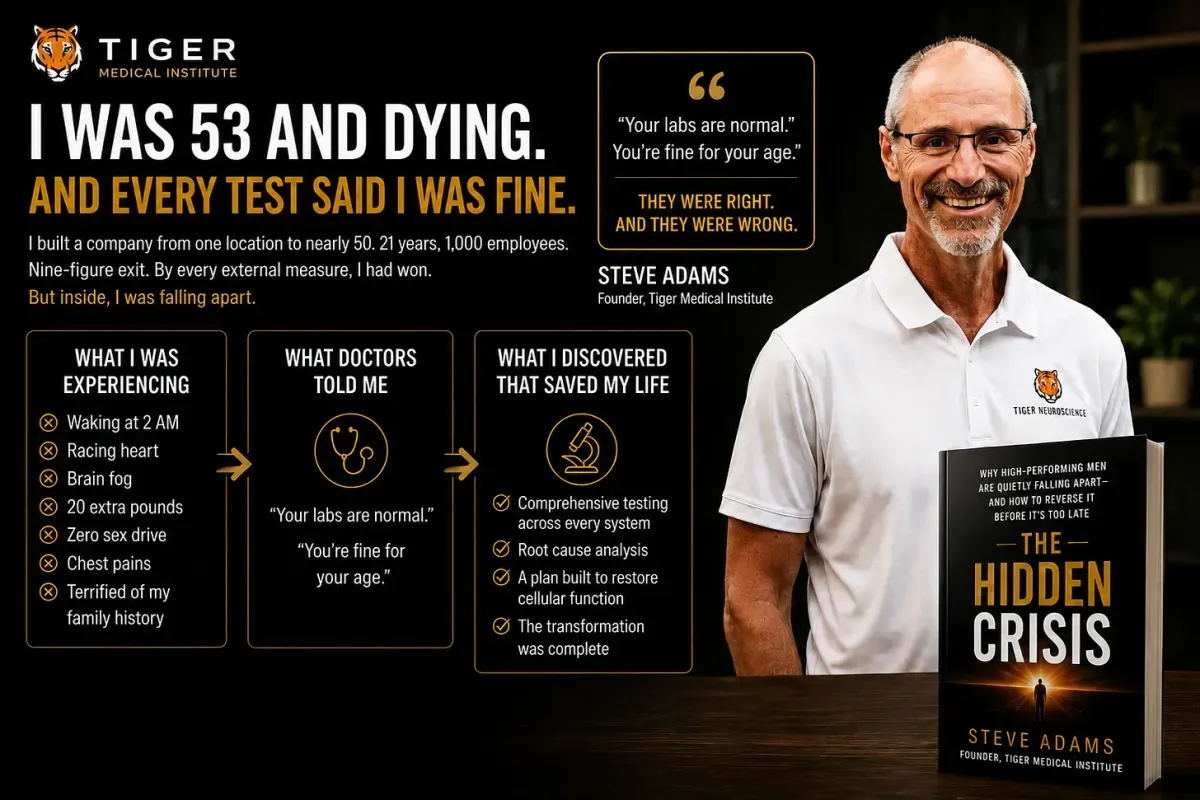
I was 53 and dying — and every test said I was fine.
The night I realized success had cost me something no doctor would name.
The night I realized success had cost me something no doctor would name.
I was 53 and dying — and every test said I was fine.
I remember the exact moment I realized I was broken.
It was 2 AM on a Tuesday. I was lying in bed, wide awake, completely exhausted. My mind was racing — tomorrow’s meetings, the deals I needed to close, the people I was letting down. My heart was pounding. My stomach was churning with acid that no amount of antacids would touch.
I had been in bed for five hours. I had slept maybe ninety minutes.
This was not new. This was every night. For years.
I was 53. I had spent twenty-one years building a company from one location to nearly fifty. From a handful of employees to almost a thousand. From modest revenue to nine figures. By every external measure, I had done exactly what I set out to do.
I had also been dying. Not dramatically. Not with a diagnosis I could give people. Quietly. From the inside out. In a way that made it easy to ignore until it wasn’t.
What I was carrying that no one saw
The tire around my belly that would not budge no matter what I tried.
The brain fog so thick I had to reread emails three times before I understood what they said.
The irritability that made me snap at my wife over nothing.
The complete absence of sex drive.
The chronic pain — joints, back, gut — that I had been writing off as the price of playing college football decades ago.
And the fear. God, the fear.
My father had his first heart attack in his fifties. His father and both his brothers died before sixty-two. All heart attacks. I had started having chest pains. I had no idea if I was about to be the next one. And every time I tried to find out, the same thing happened.
WHAT EVERY DOCTOR TOLD ME
Your labs look fine. You’re a little stressed. You’re getting older. Try to sleep more. Try to exercise more. Maybe consider an antidepressant.
This is the part of the story that took me longest to make peace with. I was not in some rural town with no access to specialists. I was a successful executive. I could get any appointment with any doctor I wanted. I went to good clinics. I had bloodwork run. I asked direct questions.
And every single time, the conclusion was some version of: you’re fine.
I was not fine.
What “normal” actually means
It took me years to understand what was happening, and the answer is so simple it is almost embarrassing.
The standard panels your doctor runs are designed to find disease. Not dysfunction. There is a difference, and it is not a small one.
Disease is what your insurance pays to treat. It has billing codes. It has medications. It is a discrete state with a name. Dysfunction is the long slope you walk down for fifteen or twenty years before disease finally announces itself. The slope is where the symptoms live. The slope is where you lose your sleep, your energy, your edge, your presence. The slope is what every man I know in his late forties and early fifties is trying to climb back up.
Standard medicine does not look at the slope. It looks at the bottom. By the time the labs flag something, you are not preventing disease. You are managing it.
“Your labs are normal” does not mean your body is functioning well. It means your body is not yet sick enough for the system to act on. Those are not the same sentence. They are not even close.
What changed
I will not tell the full story of how I got out of it today — that is a longer conversation, and it is most of what I wrote the book about. But I will tell you the moment the slope ended.
It was a single decision. Not a heroic one. Not a wellness epiphany. Just a quiet, exhausted conclusion that I was no longer willing to accept that this was the best the system had for me. I went and found a different kind of medicine — one that ran the tests no one had been running, that looked at how all my systems were working together rather than treating each one in isolation, and that built a plan around what was actually broken instead of what was billable.
What they found had been building for years. Multi-system cellular dysfunction. Not one thing. Not a simple fix. A whole network of small breakdowns that had compounded into the version of me that was lying awake at 2 AM.
When we addressed it, the difference was not subtle. The sleep came back. The clarity came back. The man I had been at 40 came back, except sharper, because everything I knew at 53 was still there. I am 62 now. I am building another company. I play on the floor with my three-year-old grandson and I am not sore the next day. I am not exaggerating any of this, and you can ask anyone who knew me ten years ago.
Why I am writing this
Because there is some version of the man I was in your inbox right now.
Maybe it is you. Maybe it is someone you love. Maybe it is the friend you keep meaning to call who has gotten quieter and heavier over the last five years and has started canceling things.
This newsletter is for him.
Every Monday for the next twelve weeks, I am going to walk through one chapter of the book I wrote about all of this. We will talk about why aging is not what you have been told it is. We will talk about the four stages between optimal and disease, and how to know where you actually are on that spectrum. We will talk about cellular health — what it is, what breaks it, what restores it — in language that does not require a medical degree.
There is no agenda here other than the one I had when I started writing the book. I spent years searching for what was wrong with me. I never want another high-performing man to search that long.
If what you read in these letters starts to sound familiar — if you find yourself nodding at the symptoms, or recognizing the system that has failed you, or quietly wondering whether you are further down the slope than you have admitted — then the book itself is the next step. You can have a copy.
CLAIM YOUR COPY OF THE BOOK
The Hidden Crisis covers what I just described, and twelve more chapters worth of what we have learned about why high-performing men decline and how to reverse it.
The book is free. I just ask you to cover shipping.

— Steve
Next Monday: why everything you have been told about getting older is wrong — and what the science actually says.