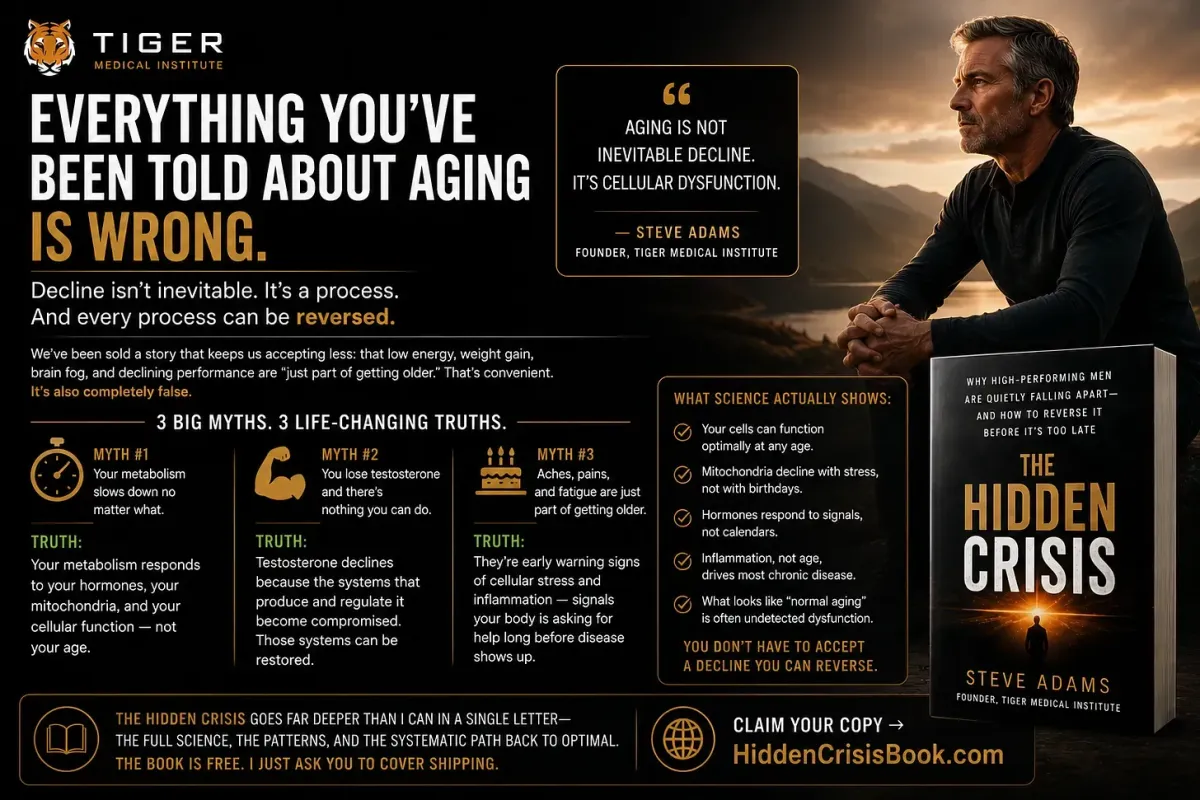
Everything you’ve been told about getting older is wrong.
Everything you’ve been told about getting older is wrong.
Here is something I want you to notice the next time you see your doctor.
You are going to walk in with a symptom — fatigue, low drive, weight that will not move, brain fog, bad sleep — and within about ninety seconds, you are going to hear one of three sentences. Maybe all three.
“You’re getting older.”
“It’s normal at your age.”
“This is just what happens.”
I heard these for years. You have probably heard them too. And I want to tell you, in the most direct way I know how, that they are wrong. Not partially wrong. Not technically-but-also-true. Wrong.
The lie inside “normal for your age”
When your doctor says something is normal for your age, what they actually mean is: this is the average outcome in a population where chronic disease is the expected endpoint of life.
Read that sentence again. Because it is not what most men hear when their doctor uses the word normal.
The reference range your labs are graded against is built from the general population. Most of the general population is sick or on the way to being sick. The reference range is therefore a measurement of the average outcome of a system that does not work. When your labs come back “in range,” it means you are not yet an outlier within a sick population. It does not mean your body is functioning well.
This is the trap. The system uses the word normal to mean two completely different things, and almost no one explains the difference.
Normal can mean: not yet sick enough to require intervention. That is the meaning your doctor is using.
Normal can mean: functioning the way a healthy body is supposed to function. That is the meaning you are hearing.
These are not the same. When you walk out of that appointment thinking you got a clean bill of health, you actually got a clean bill of statistical proximity to a sick average. That is a very different thing.
Aging is not what is happening to you
The deeper lie is that the slope you are on is the slope of getting older.
It is not.
Your chronological age — the number of years you have been alive — is fixed. There is nothing to do about it. But your biological age — the rate at which your cells, your tissues, your organ systems are actually deteriorating — is not fixed. It is a function of what your body has been exposed to, what it has been fed, what it has been protected from, and what it has been pushed to do.
Two men can be the same age on paper and twenty years apart on the inside. You know this is true because you have met both of them. You have met the 65-year-old who looks 50 and the 50-year-old who looks 65. The difference between them is not luck. It is also not genetics, except in a much smaller way than people assume. The difference is what their cells have been doing for the last three decades.
This is the part that took me the longest to accept, because it is the part with the most personal accountability in it. The decline I was experiencing at 53 was not the inevitable cost of being 53. It was the cumulative cost of twenty-five years of running a company on inadequate sleep, eating whatever was in front of me, ignoring symptoms, and trusting a medical system that was not designed to find dysfunction. The number on my driver’s license was a small part of it. The number on every other measurement was the bigger part.
What the science actually says
In the last fifteen years, the research on cellular aging has clarified to a point that should be obvious from any medical practice but somehow is not. The decline we describe as “aging” is, at the cellular level, almost entirely a function of four things.
First, mitochondrial function — your cells’ ability to produce energy.
Second, inflammation — the slow, smoldering damage that accumulates when your immune system never gets to stand down.
Third, hormonal signaling — the communication network that tells every cell in your body what to do and when.
Fourth, the load of accumulated damage — from toxins, from oxidative stress, from infections your immune system never fully cleared, from a gut that stopped working two decades ago and has been quietly inflaming your whole system ever since.
Every one of those four is measurable. Every one of those four is modifiable. None of them are on the standard physical. None of them are what your insurance is paying to investigate.
This is what people mean when they say the medical system is not built for prevention. It is not even built for early detection. It is built to identify disease at the point of billable diagnosis. The fifteen years of cellular dysfunction leading up to that diagnosis are invisible to the system, by design.
What this changes
If aging is mostly cellular, then the conversation about what to do about it changes entirely.
It is no longer a conversation about accepting the slope. It is a conversation about investigating the slope, identifying the specific cellular dysfunctions that are putting you on it, and addressing them in sequence.
This is what comprehensive cellular health work actually is. It is not a supplement stack. It is not a biohack. It is not a thirty-day reset. It is a structured investigation, followed by a structured response, conducted with physicians who are looking for dysfunction rather than disease.
I am 62. I sleep deeply. I am sharp all day. I am building another company. I have more physical capacity now than I had at 45. None of that is because I beat the calendar. It is because I stopped accepting that the decline I was on at 53 was an aging problem.
It was a cellular problem. And cellular problems can be solved.
Next Monday, we will talk about what your body is actually telling you when these symptoms show up — and why most doctors are not trained to listen for it.
CLAIM YOUR COPY OF THE BOOK
The Hidden Crisis goes deep into the science of cellular aging and what to do about it. The book is free. I just ask you to cover shipping.
Claim your copy → HiddenCrisisBook.com
Link the CTA above to:
https://www.hiddencrisisbook.com/shipping-free-book
— Steve